

Download our free guide: Allergen Labelling in Practice – A Practical Guide for Food Businesses
Managing allergens correctly ensures your operations meet regulatory requirements, keeping your business safe from fines or worse. It also protects your customers, supports your team, and builds trust through accurate and consistent information.
Allergen management is a tricky thing, however, and it is becoming increasingly complex. Recipes change, for example, suppliers update ingredients, teams work across multiple locations, and busy service environments create more opportunities for information to become outdated or inconsistent.
Our latest guide, Allergen Labelling in Practice, helps food businesses understand the key labelling requirements for allergen safety, including what needs to be included on each and every label to ensure compliance, and practical steps needed to create a reliable allergen labelling process.

Why Allergen Labelling Is So Important
The importance of accurate allergen information is reinforced by the National Allergy Strategy, published in April, which sets out a coordinated approach to improving the lives of people living with allergies across the UK.
As reported by the Medicines and Healthcare products Regulatory Agency, hospital admissions linked to anaphylaxis have more than doubled over the past two decades, from 12,361 cases recorded in 2002 to 2003 to 25,721 in 2022 to 2023.
People living with food allergies rely on information that is clear, consistent, and trustworthy to make safe choices. This was a key highlight presented by the National Allergy Strategy, and in practice, this places significant responsibility on food operators to ensure that what is written on a label reflects exactly what is in the product.
Clear and accurate allergen information can make the difference between a safe dining experience and a serious health risk for customers living with allergies. For businesses, allergen labelling sits at the intersection of food safety, compliance, and customer confidence. Getting your allergen labelling right requires both a deep understanding of the regulations and instituting processes that help teams consistently apply the right information whether in the front of the back of the house.
The challenge is rarely a lack of awareness. More often, issues occur when processes rely on manual updates, individual knowledge, or inconsistent ways of working.
Understanding the Complexity Behind Allergen Management
Food businesses must manage allergen information across every stage of production. Ingredient selection, preparation, packaging, and service all deserve proper allergen attention to avoid the following:
- Temporary substitutions not being communicated effectively
- Different sites using different labelling approaches
- Teams relying on memory instead of documented information
- Labels being incomplete, unclear, or difficult to read
- Ingredient changes not being reflected on labels
These challenges become harder to manage as operations grow. A process that works for one location may become difficult to control across multiple kitchens, teams, or service points. A consistent approach therefore helps businesses reduce risk and ensure allergen information remains accurate wherever food is prepared and served.
The Role of Back-Of-House Labelling
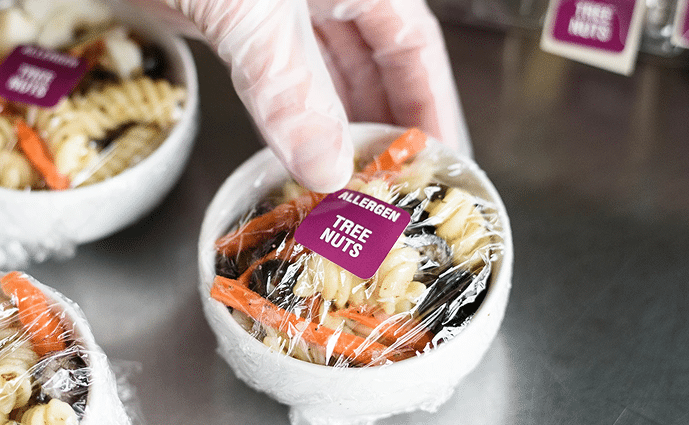
Effective allergen management starts long before food reaches the customer. Labelling in the back-of-house provides the foundation for accurate allergen communication. How? By helping teams identify products, manage storage, and follow safe handling procedures.
Clear labels on containers, trays, and prepared ingredients allow staff to quickly understand what they are working with and reduce the risk of mistakes during busy periods. When businesses connect recipe information with label generation, they create a single source of truth. This reduces duplication and helps ensure allergen information remains consistent from preparation through to service.
Moving from manual processes to a system-led approach
As food operations become more complex, relying on manual processes makes maintaining accuracy increasingly difficult. A system-led approach helps businesses standardise how they manage allergen information by connecting vital pieces like recipe data, ingredient information, allergen details and label production.
This allows updates to flow through consistently, reducing the risk of outdated information appearing on labels. By creating repeatable processes, businesses can then more easily support their teams, improve confidence, and strengthen allergen control across their operations.
Our guide dives deep into the following issues:
- The key allergen labelling requirements businesses need to understand
- How to create consistent labelling processes
- Common causes of allergen management failures
- Practical approaches for front-of-house and back-of-house environments
- How digital tools can support accuracy and consistency

Download your free copy of Allergen Labelling in Practice – A Practical Guide for Food Businesses heute.