

Most kitchen waste isn’t decided at the bin. It’s decided days earlier, when a tub goes into the fridge without a clear name, a prep date nobody can read, or a day dot that doesn’t match the house system.
When the team can’t tell what something is or how long it has left, the only safe choice is to throw it away. Multiply that by every container, every shift and every site, and unclear labelling becomes a steady, hidden cost.
Organised labelling tackles that cost at source. Clear, consistent labels help teams use stock in the right order, avoid over-prepping, and record what is being wasted, so buying decisions can be based on evidence rather than habit.
Where Kitchen Food Waste Really Comes From
WRAP estimates that the UK hospitality and food service sector throws away 1.1 million tonnes of food a year. Three quarters of it could have been eaten, and the waste costs businesses £3.2 billion annually. Almost a fifth of all food the sector buys ends up in the bin (WRAP).
WRAP’s earlier breakdown shows where that waste arises: on average 21% from spoilage, 45% from food preparation and 34% from customer plates (The Caterer). Spoilage and preparation, two thirds of the total, happen in the back of house, which is exactly where labelling does its work.
Food Waste Management: Many Larger Businesses Still Don’t Measure Waste
WRAP’s guidance encourages businesses to target, measure and act on food waste. Yet Biffa research published by UKHospitality in 2024 found that only 41% of corporate-sized hospitality businesses measured their food waste, although another 47% planned to start (UKHospitality). That leaves a real opportunity for practical, everyday ways to see what is being wasted and why.
The Label’s Role In Food Spoilage And Over-Prep
Spoilage often starts with a missing or unclear label. Food gets pushed to the back of the shelf, its date can’t be read, or two batches of the same item sit side by side with no way of telling which came first. Over-preparation follows a similar pattern: without a clear view of what is already prepped and how long it has left, teams make more to be safe.
How Core Labels Keep Stock Moving
Core labels are the everyday tools of waste control. They don’t need technology to work, only consistency: the same labels, used the same way, on every container.
Clear Identification
A clear item name means nothing is binned simply because nobody is sure what it is. “Use By” labels give the team one place to record the product, when it was prepared and when it must be used.
Colour-Coded Day Dots For FIFO Stock Rotation
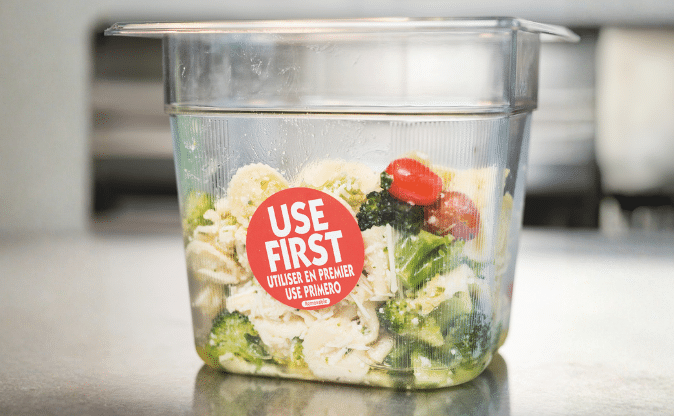
Day dots turn first in, first out (FIFO) into something the team can see from across the walk-in. When every site uses the same colour for the same day, older stock is picked first without anyone having to read a date. “Use first” labels add a second signal for items that need to go today.
Freezer Labels That Stay Put, Dissolvable And Removable Labels That Come Off Clean

A label only prevents waste if it is still attached and readable when it matters. Paper weight and adhesive need to suit the conditions the label will face, whether moist, warm or cold. Freezer and cold-store labels such as DuraPeel™ are designed to stay on in demanding conditions. For reusable containers, removable and dissolving labels release cleanly at washing, so tubs go back into service rather than being discarded because of stubborn residue.
If a label falls off and staff cannot identify the contents or establish when they should be used, food may have to be discarded.
How the DateCodeGenie® Food Labelling System Turns Labels Into Waste Data
Core labels make waste visible on the shelf. DateCodeGenie® goes a step further, turning every label into a record that managers can act on.
Accurate Use-By Dates, Every Time
DateCodeGenie calculates use-by dates automatically from each product’s set shelf life, so there is no miscounting and no rounding down “to be safe”. Labels can be configured to show the information each team needs, including expiry dates in the format that suits the operation, which makes it easier to see at a glance what should be used first. Printed labels look the same whoever is on shift, removing the guesswork that leads to good food being thrown away.
Food Waste Tracking: Recording What Is Prepped And What Is Wasted

DateCodeGenie’s product control functionality connects preparation with what happens next. Preparation is logged through the printed labels, and items can be tracked using barcodes or QR codes. When something is discarded, it is recorded against the original quantity prepared, so waste is visible in relation to the products being produced rather than as a single bin weight.
From Reports To Better Ordering
Waste data is only useful if it changes what happens next. Costs can be assigned to items in the DateCodeGenie portal and included in custom reports covering raw material costs, sales and the financial impact of waste. Reports showing consistent over-prep or spoilage on particular items give kitchen and purchasing managers the evidence to adjust par levels, prep quantities and order sizes, rather than relying on instinct.
Buying Food Labels Responsibly
Waste control doesn’t stop at food. The labels themselves are a recurring purchase and choosing them well means looking at two things: how they perform in daily use, and what evidence backs up their environmental credentials.
Judge Labels By How They Perform In Daily Use
The greenest label is one that does its job first time. A label that falls off in the freezer, smudges in condensation or won’t come off at washing creates waste of its own: relabelling, discarded food of unknown age, or containers thrown away because of residue. Before switching products, test them in your own conditions, on your own containers and through your own cleaning process.
Match The Material To What Happens Next
Think about where the label ends up. Dissolving labels wash away with the water, so there is no peeled label to dispose of, while removable labels let reusable containers go straight back into service. Always follow the label and container manufacturers’ approved cleaning instructions.
Ask For Product-Specific Evidence
Environmental claims are only as good as the evidence behind them. When comparing labels, ask for documentation that applies to the specific product you are buying, not just the supplier in general. Useful questions include where the label is made, which certifications cover the face material, liner and adhesive, and what happens to each component after use.
NCCO’s labels are manufactured in the UK from FSC-certified paper, and the FSC-certified range is supplied through many of the UK and Ireland’s largest distributors. NCCO can provide product-specific information on request to support your purchasing decisions.
Organised Food Labelling In Practice
Two everyday examples show how labelling and DateCodeGenie® product control connect what is prepared with what is lost.
Tracking Prepared Items: The Cucumber Example
A kitchen prepares and labels 15 containers of cucumber using DateCodeGenie. Later, one container falls on the floor. Instead of disappearing into the bin unrecorded, it is logged as wasted against the original 15. The operator can see both what was prepared and what was subsequently lost, which tells them far more than a total bin weight alone.
Making Waste Visible In Sandwich Production
The same approach works for sandwiches. Teams track the quantities made and record any that are discarded, scanning items in and out using barcodes or QR codes on the printed labels. The handheld DateCodeGenie® Mini offers a portable way to capture this activity. Costs can be assigned in the DateCodeGenie portal and included in custom reports, so operators can examine raw material costs, sales and the financial impact of waste side by side.
Every item discarded represents money already spent, often alongside preparation time, storage and energy.
Our contribution is to help customers manage ingredients and consumables more effectively before they become waste, while providing records that make losses easier to understand.
Questions To Review Your Kitchen Labelling Setup
Use these questions to spot where labelling may be contributing to waste in your operation.
For Kitchen And Operations Managers
- Does every container in the chiller and freezer have a readable item name and date?
- Does every site use the same colour-coded rotation system?
- Are use-by dates calculated consistently, or estimated by whoever is on shift?
- Do labels stay on and stay legible in your freezers and cold stores?
- Do labels come off cleanly at washing, or are containers being scraped or discarded?
- Do you know which items are wasted most often, and why?
For Purchasing Managers
- Have you tested labels in your own conditions before buying in volume?
- Are you buying labels for the job each one does, or a single label for every task?
- Do you have product-specific evidence for any environmental claims you rely on?
- Could waste data be used to adjust par levels and order quantities?
For Distributor Buyers
- Does your range cover rotation, dissolving, freezer-rated and removable options?
- Can you support customers who want to move from handwritten to printed labels?
- Can you supply product-specific evidence to customers who ask about environmental attributes?
Review Your Labelling Setup
Small changes to how food is labelled can make a real difference to how much is thrown away. If any of the questions above gave you pause, it may be time for a closer look.
Contact NCCO or speak to your distributor to review your labelling setup, from core rotation labels to DateCodeGenie® waste reporting.
UK: +44 (0) 128 352 7977 · nccouk@ncco.com
Ireland and EU: +353 (0) 1 853 7322 · nccoeu@ncco.com