
Change in foodservice is nothing new. Long before digital systems entered the conversation, professional kitchens were already defined by their ability to adapt. From the introduction of structured kitchen hierarchies to modern food safety legislation, progress has always relied on a willingness to rethink how work gets done.
One of the most influential shifts came in the late 19th century, when Auguste Escoffier introduced the Brigade System. This system seemed radical to the foodservice establishments of the time: clear roles, defined responsibilities, and a disciplined workflow. Yet those principles of structure, efficiency and accountability quickly became the backbone of professional kitchens across Europe and beyond.

Since then, the industry has continued to evolve. Refrigeration transformed food storage and menu planning. HACCP became standard practice in the 1990s, embedding risk awareness into daily operations.
More recently, allergen transparency and compliance requirements have reshaped how information is tracked and shared. Each development initially felt disruptive, but each ultimately made kitchens safer, more consistent and more profitable.
Now, digital tools offer the next step in that same journey.
New Pressures and New Habits in Post-Pandemic Kitchens
The COVID-19 pandemic had a permanent effect on the hospitality industry. Staffing shortages, higher turnover, increased scrutiny around food safety, and tighter margins have forced operators to reassess how their kitchens function day to day.
As a result, many teams have already changed their behaviour in subtle but important ways. Flexibility and clarity are must-haves. Processes are being simplified. Tasks are being standardised. Managers are spending less time on paperwork and more time supporting their teams on the floor.
Technology fits naturally into this shift. But it must be approached as a behavioural change, not simply as a tool.
Reinforcing Discipline with Digitised and Automated Tools
For operators who have spent years building strong kitchen disciplines, adopting digital systems can sometimes feel like a departure from tradition. It is, however, quite the opposite.
The same principles Escoffier championed over a century ago, i.e., clarity, structure and efficiency, are exactly what modern back-of-house technology delivers.
Digital systems, like automated date coding, digital labelling and centralised records don’t remove responsibility from teams. They make responsibility visible. They reinforce accountability by standardising tasks, reducing human error and creating clear audit trails. Instead of relying on memory, handwriting or inconsistent processes, teams can trust systems that work the same way, every time.
This consistency is particularly valuable in today’s kitchens, where teams are often stretched and experience levels can vary. Technology provides a shared framework that supports both new starters and seasoned professionals.
Small Workflow Changes Create Large Cultural Impact
A major misconception about technology adoption is that it requires a complete overhaul of how a kitchen operates. In reality, the most successful changes are often the smallest.
Replacing handwritten labels with digital ones, for example. Or automating date calculations and removing manual logs in favour of simple, guided systems. These changes might seem minor at first. But over time, their impact is cumulative. These new processes reduce friction, free up mental bandwidth and allow teams to focus on food quality and service rather than admin.
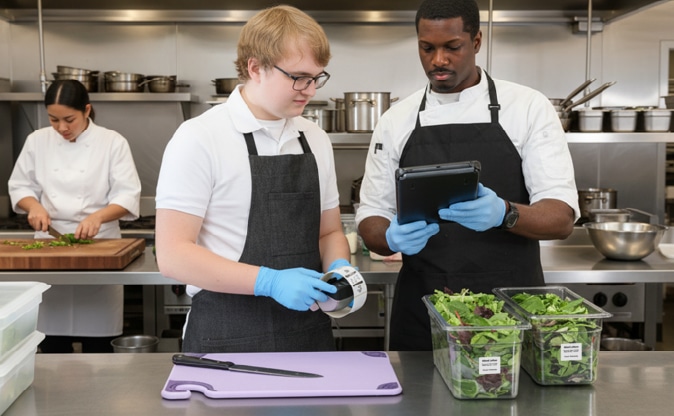
When systems are easier to use, compliance becomes habitual rather than enforced. When expectations are clear, accountability feels fair rather than punitive. When information is reliable, managers can lead with confidence.
Hospitality has always moved forward by embracing ideas that initially felt unfamiliar. What once seemed radical quickly became routine because it worked. Back-of-house technology allows foodservice operators the opportunity to build on established foundations, and a chance to support teams with tools that reflect the realities of modern kitchens.
Behaviour change doesn’t happen overnight. But when technology is introduced thoughtfully, aligning with existing values and workflows, it becomes an extension of what great kitchens already do well.
Technology therefore earns its place not as a bolt-on, but as part of modern kitchen culture.